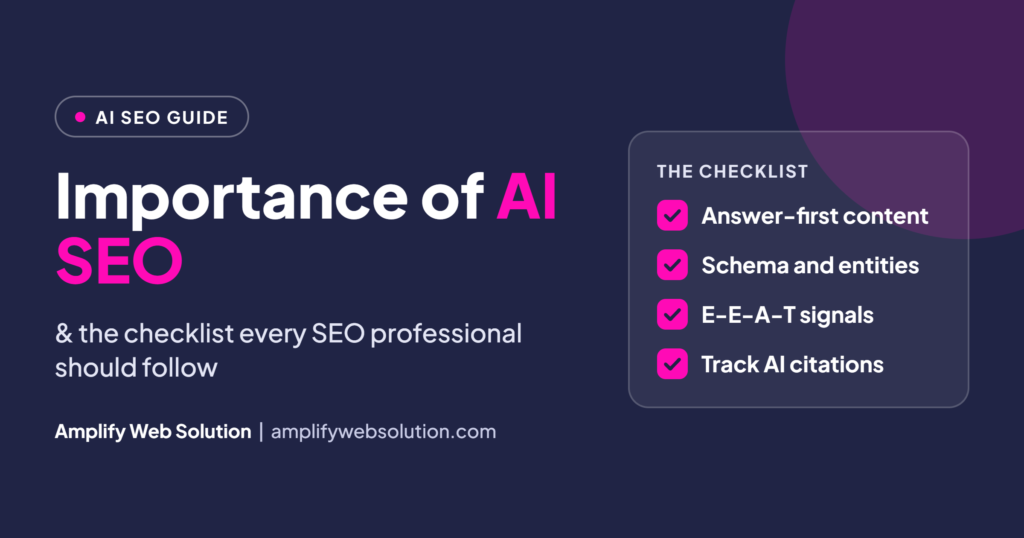
Importance of AI SEO & Checklist Every SEO Professional Should Follow
Search is no longer just ten blue links. People now get answers from Google AI Overviews, ChatGPT, Perplexity, Gemini, and Copilot, often without ever clicking a website. For SEO professionals, this is not the end of SEO. It is the next layer of it. AI SEO is the practice of optimizing your content, site, and brand so that both traditional search engines and AI-powered answer engines can find, understand, trust, and cite you.
In this guide, we explain why AI SEO matters and give you a practical checklist you can apply to every client project.
What Is AI SEO?
AI SEO covers two connected areas:
- Using AI tools to do SEO faster, such as keyword clustering, content briefs, audits, and reporting.
- Optimizing for AI-driven search, also called Generative Engine Optimization (GEO) or Answer Engine Optimization (AEO), so your content gets surfaced and cited inside AI-generated answers.
A modern SEO professional needs both. Tools help you scale. Optimization for AI search protects and grows your visibility where users are actually asking questions.
Why AI SEO Is Important
1. Search behavior has changed
Users ask longer, conversational questions and expect a direct answer. AI engines summarize information from multiple sources, and the sources they pick get the visibility. If your content is not structured to be picked, you are invisible in that layer.
2. Zero-click results are growing
AI Overviews and answer boxes resolve many queries on the results page. Rankings still matter, but being cited inside the answer is becoming just as valuable as being ranked below it.
3. Brand and entity trust now drive visibility
AI systems lean on entities, consistent brand mentions, and credible sources. Strong E-E-A-T (experience, expertise, authoritativeness, trustworthiness) signals help both Google and AI engines decide whom to trust.
4. Competitors are already adapting
Agencies and brands that structure content for AI citations early are building an advantage that gets harder to catch up with over time.
5. AI speeds up your workflow
Used well, AI cuts hours from research, outlines, schema generation, and reporting. That time can go to strategy, quality control, and client communication, which is where professionals add the most value.
6. Traditional SEO is still the foundation
AI engines still rely on crawlable, indexable, fast, well-structured websites. AI SEO builds on technical and content fundamentals. It does not replace them.
The AI SEO Checklist Every SEO Professional Should Follow
A. Strategy and research
- Identify the questions your audience asks, using Google’s People Also Ask, Search Console queries, forums, and AI tools.
- Group keywords by intent (informational, commercial, transactional), not just volume.
- Check which queries already trigger AI Overviews and which sites get cited.
- Map each target topic to one page to avoid keyword cannibalization.
- Define the entities and topics your brand should be known for.
B. Content quality and structure
- Answer the main question directly in the first 2-3 sentences of the page or section.
- Use clear headings (H2/H3) written as questions or clear topics.
- Add short, scannable paragraphs, bullet lists, and comparison tables where useful.
- Include an FAQ section with concise, self-contained answers.
- Add original value: real examples, data, screenshots, case studies, or first-hand experience.
- Keep facts current, with dates and updates visible.
- Never publish raw AI output. Fact-check, edit, and add a human voice.
C. E-E-A-T and brand signals
- Show real author names, bios, and credentials.
- Cite reputable sources and link out where it helps the reader.
- Keep your About, Contact, and policy pages complete and transparent.
- Build consistent brand mentions across LinkedIn, directories, industry sites, and review platforms.
- Earn quality backlinks and digital PR mentions, not just volume.
- Keep Google Business Profile details accurate for local businesses.
D. Technical SEO
- Make sure key pages are crawlable and indexable (robots.txt, canonical tags, XML sitemap).
- Check that AI crawlers you want visibility from are not blocked by mistake.
- Improve Core Web Vitals and mobile experience.
- Use clean URLs, logical internal linking, and a flat site structure.
- Fix broken links, redirect chains, and duplicate content.
- Render important content in HTML, not hidden behind heavy JavaScript.
E. Structured data and entities
- Add relevant schema: Organization, Article, FAQPage, LocalBusiness, Product, Review, and Breadcrumb.
- Use
sameAslinks to connect your brand to official social profiles. - Validate markup with the Rich Results Test and Schema Markup Validator.
- Keep names, addresses, and descriptions consistent everywhere.
F. On-page optimization
- Put the primary keyword in the title, H1, URL, and intro naturally.
- Write unique title tags (50-60 characters) and meta descriptions (150-160 characters).
- Add descriptive alt text to images.
- Link internally to related pages with meaningful anchor text.
- Match the Rank Math or Yoast focus keyword, but write for people first.
G. Using AI tools responsibly
- Use AI for research, outlines, clustering, and drafts, never as the final word.
- Verify every statistic, claim, and source.
- Follow Google’s guidance on helpful, people-first content.
- Keep client data and confidential information out of public AI tools.
- Document your AI workflow so results are repeatable and auditable.
H. Measurement and monitoring
- Track impressions, clicks, and queries in Google Search Console.
- Monitor branded search growth, a strong signal of rising authority.
- Manually test priority queries in ChatGPT, Perplexity, Gemini, and Google AI Overviews, and note whether your brand is cited.
- Review referral traffic from AI platforms in GA4.
- Refresh underperforming content every quarter.
- Report on business outcomes (leads, calls, sales), not just rankings.
Common AI SEO Mistakes to Avoid
- Mass-producing thin AI content. It adds volume but no value, and it risks quality demotions.
- Ignoring technical basics. A great answer on an unindexable page helps no one.
- Chasing tools instead of strategy. Tools support the plan. They are not the plan.
- Skipping brand building. AI engines cite brands they recognize and trust.
- Not measuring. If you do not track citations and visibility, you cannot improve them.
Frequently Asked Questions
Is AI SEO replacing traditional SEO?
No. AI SEO extends traditional SEO. Crawlability, quality content, authority, and user experience still decide who gets ranked and cited.
How do I get my website cited by AI tools?
Publish clear, accurate, well-structured answers, support them with credible sources and original insight, use schema, and build a strong, consistent brand presence across the web.
Can AI-written content rank?
It can, if it is original, accurate, helpful, and reviewed by a human expert. Unedited, generic AI content usually does not perform.
How long does AI SEO take to show results?
Like traditional SEO, expect a few months for meaningful movement, depending on competition, site authority, and content quality.
Final Thoughts
AI has changed how people find information, but the goal of SEO is the same: be the most helpful, trustworthy answer for the user. SEO professionals who combine strong fundamentals, clear and structured content, solid brand authority, and smart use of AI will lead the next era of search.
Use this checklist on every project, audit it regularly, and keep testing as AI search evolves.
Need help making your website visible in both Google and AI search? The team at Amplify Web Solution can audit your site and build an AI-ready SEO strategy. Get in touch today.